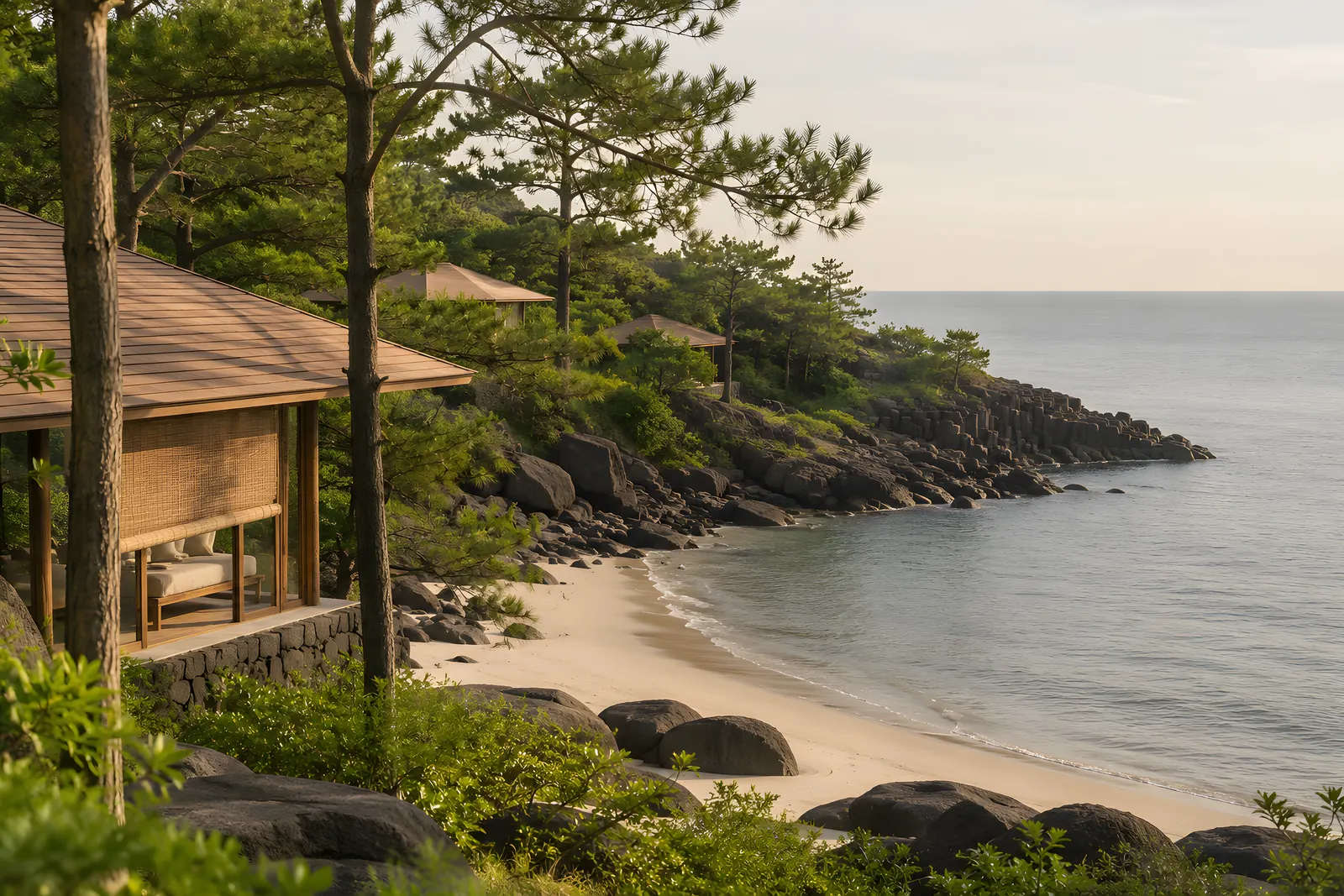
Before the sun reaches the hillside, the sea begins to change colour. The horizon becomes visible, then the darker shapes of the rocks below it. What first appears as one continuous shoreline gradually separates into individual surfaces, edges and pools of water.
On Vietnam’s south-central coast, volcanic basalt is part of the landscape. It gives the shore a different character from a continuous stretch of sand. Stone meets the water directly, and the changing light reveals details that are difficult to see in darkness.
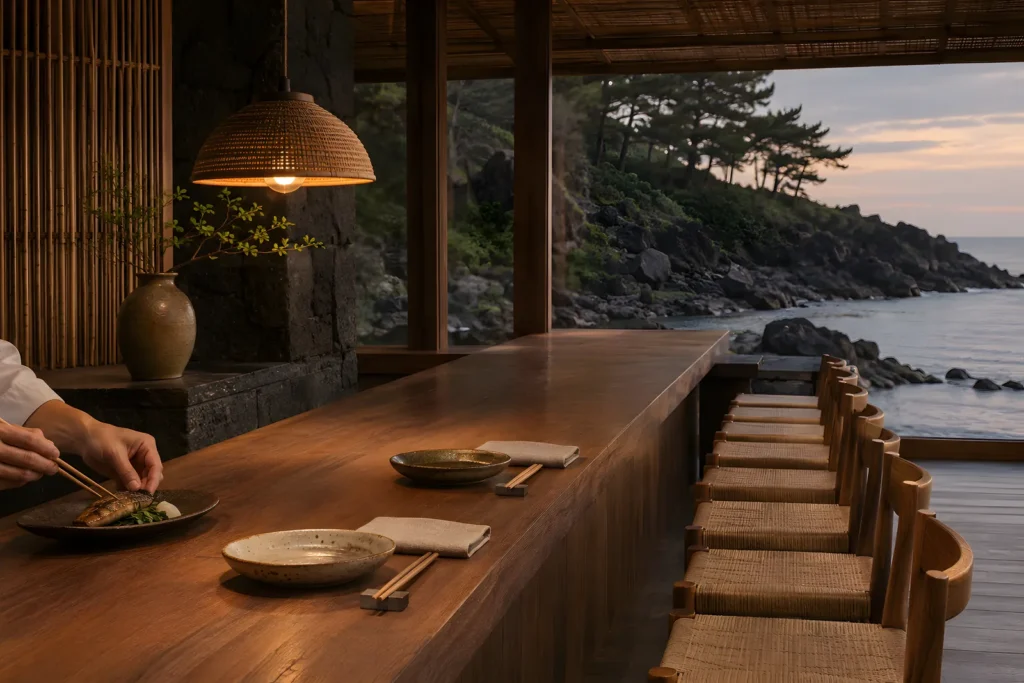
This is the landscape imagined for ASAIWA.
The meaning of morning rock
ASAIWA takes its name from two Japanese characters. 朝 means morning. 岩 means rock.
Together, they give the name its intended meaning: morning rock.
The name refers to a simple feature of the imagined place. The cove faces east, towards the first light over the sea. Along its edge are dark volcanic rocks, formed long before any building could be placed beside them.
Basalt begins as molten rock. As lava cools and contracts, fractures can develop. Under suitable conditions these fractures form columns, often with several sides. The columnar basalt found along parts of Vietnam’s south-central coast is a visible record of that cooling process.
The geometry can look almost deliberate, although it was formed without a designer. Straight edges meet irregular surfaces. Repetition exists beside variation.
For a place built around stone and water, this is a useful starting point.
A bath of one’s own
ASAIWA is imagined across approximately nine hectares of hillside, with 36 rooms and villas. Every room has a private bath, although the setting and material differ.
The Stone Garden Room has an indoor wooden tub facing moss and stone. The Hillside Villa has an outdoor stone bath among the pines. At the Cliff Bath Villa, a heated basalt bath stands on a deck facing the open sea.
These differences matter. A garden, a hillside and a cliff do not offer the same relationship with the landscape. Nor does every room look towards sunrise.
The baths use heated well water rich in minerals. Their warmth is prepared for bathing, rather than supplied by a naturally heated spring.
Leaving before the day begins
The coast can also be approached from the water.
At ASAIWA, the illustrated sunrise boat experience travels to a fishing village. The journey lasts three hours and costs VND 1,800,000 per guest.
The boat gives another perspective on the shore. From the sea, the shapes of the headland, the basalt and the hillside can be understood together.
Returning to the coast, the light will have changed again. The rocks remain where they were, but their surfaces look different as the morning develops.
The name ASAIWA belongs to this meeting of something permanent and something that returns each day.